Contact us

Why GEO is the next frontier in digital visibility

SVP Adobe
Valtech

December 02, 2025

For decades, marketers have obsessed over rankings, optimized keywords and refined our content architecture around the algorithms that decided who won digital real estate. Search Engine Optimization became the lingua franca of digital strategy.

But something fundamental is shifting. And if you're still thinking about digital visibility purely through an SEO lens, you're missing the biggest change since the rise of mobile. 

Users aren't just searching anymore. They're asking. And increasingly, they're getting answers not from a list of blue links, but from AI systems that synthesize, summarize and serve insights directly into the conversation. 

This is the era of Generative Engine Optimization (GEO), and it's redefining what visibility means. 

We've gone from algorithms to answers 

Let's start with the data.

According to Adobe's recent analysis, US retail sites experienced a 3,500% surge in traffic from generative AI sources between July 2024 and May 2025. Meanwhile, Bain & Company reports that 80% of consumers now rely on AI written summaries for at least 40% of their information needs. And Gartner projects a 50% decline in traditional organic search traffic by 2028. 

These are clear and early signals of how discovery is being rewired. 

Generative engines like ChatGPT, Gemini, Claude, Copilot and Perplexity are becoming the new gatekeepers of content. They're sensemaking engines that don't just retrieve information; they interpret, synthesize and contextualize it. And crucially, they decide whose voice gets heard in the conversation. 

The consequence is stark: "zero-click" interactions are climbing. Users find their answers without ever visiting your website. Your brand becomes a footnote or disappears entirely. 

For digital leaders, the question is no longer "How do we rank?" It's "How do we get understood?" 

GEO vs. SEO: A false choice 

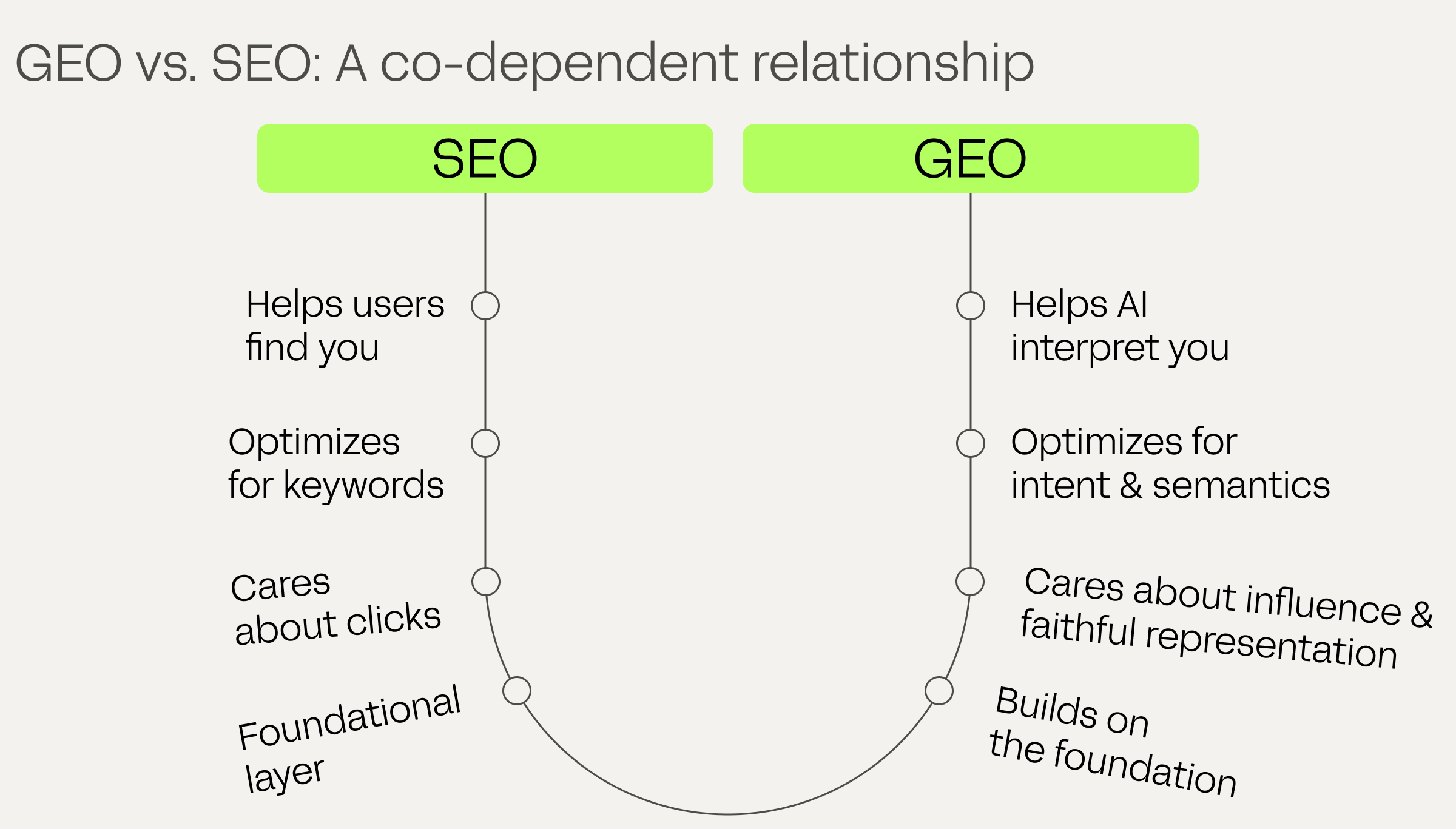
Diagram illustrating the interrelationship between SEO strategies and their impact on search engine optimization outcomes.

Here's where many organizations get it wrong: they see GEO as a replacement for SEO. A pendulum swing from one discipline to another. 

That's a mistake. 

The truth is more nuanced and far more strategic. SEO and GEO are co-dependent layers of a modern digital ecosystem. 

SEO remains foundational. It ensures your content is structured, discoverable and authoritative in traditional search. It's the hygiene layer: metadata, schema markup, backlinks, content authority. Without it, you're invisible to both search crawlers and AI models. 

But GEO builds on that foundation. It answers a different question: How do AI systems understand and represent your brand? 

This means: 

  • SEO helps users find you. GEO helps AI systems interpret you accurately enough to cite, trust and include you in their answers. 
  • SEO optimizes for keywords. GEO optimizes for intent, entity relationships and semantic understanding. 
  • SEO cares about clicks. GEO cares about influence and whether your expertise is represented faithfully in AI-generated responses. 

Neglect SEO, and your content never reaches the systems in the first place. Neglect GEO, and your content gets misunderstood, misrepresented or attributed to competitors. 

The winners won't be those who choose between SEO and GEO. They'll be the ones who see them as an integrated whole. 

A critical point: LLMs don't understand your content the way search engines do. They're not crawling your internal links or scanning for keywords. Instead, they ingest your content as tokens and look for semantic clarity like clear concepts, logical flow and context. This is why well written, poorly structured content can outperform keyword optimized pages with perfect schema. Structure, clarity and authenticity matter more than any single tactic. 

The architecture of interpretation: How brands become "understandable" 

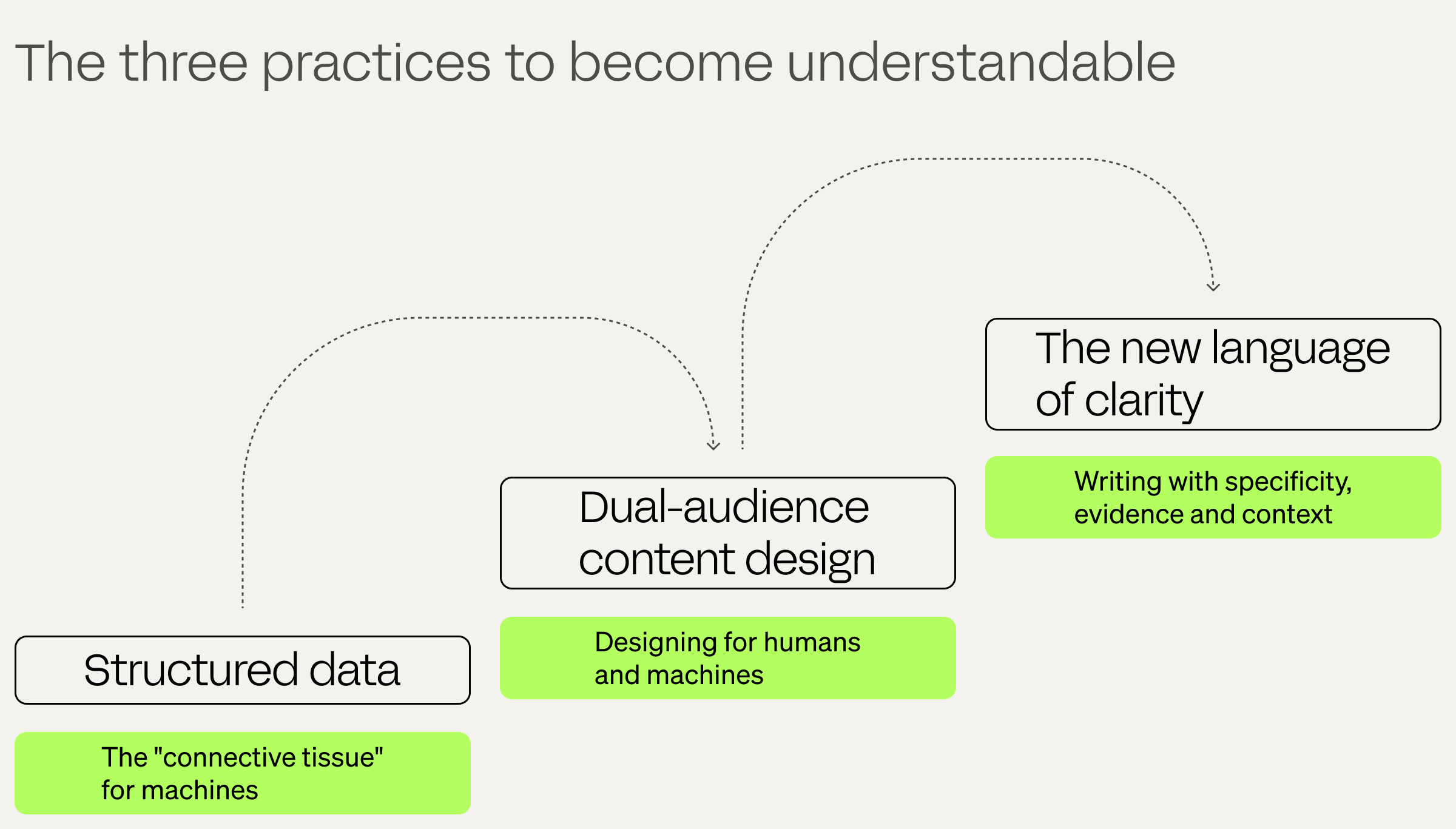
A mind map illustrating the concept of "geo quick wins" with interconnected ideas and keywords.

Here's what's changing about content strategy: it's no longer enough to be found. You have to be interpretable. 

Three practices are emerging as table stakes: 

  1. Structured data as connective tissue

In a generative world, schema markup, entity tagging and linked data are essential. Structured data tells AI systems what your content is about, how it relates to other information and why it matters. It's the bridge between human language and machine understanding. Without it, even brilliant content becomes noise in the model's training data. 

How to start: Implement organization, person and product schema markup on your key pages. This makes it easier for LLMs to extract and cite your content cleanly. But schema works best when paired with semantic consistency: your brand name, description and expertise are described identically across your own site and third-party mentions.

  1. Content design for dual audiences

Traditional web design asks: "How do users navigate this?" Modern GEO-ready design asks: "How do humans and machines navigate this?" 

This means consistent, context-rich metadata across every piece of content. It means hierarchies that map to business entities, not just website menus. It means every piece of content has a clear semantic purpose. Not just keyword coverage, but topic depth and topical authority. 

How to start: Audit your top 50 pages. For each, document: What is this page's single core entity or topic? Who authored it? What's the authority signal? Then standardize meta descriptions and H1s to reflect that intent clearly. AI models need coherence. Write title tags and introductions that state intent explicitly, not vaguely. 

  1. The new language of clarity

Forget keyword density. GEO demands something more rigorous: intent modeling through clarity. 

Every word becomes a signal. Brands need to write with precision, evidence and purpose so that AI systems can confidently cite their expertise. You're not just writing for your audience anymore. You're writing for algorithms that will decide whether to trust and attribute your work. 

How to start: Rewrite key content with three principles: specificity (avoid vague terms and name what you mean), evidence (back claims with data, sources or expert attribution) and context (explain the "why" alongside the "what"). Include bylines and expertise markers to help models understand who's speaking and whether they should trust them. 

Moving From theory to practice: GEO without waiting for tools 

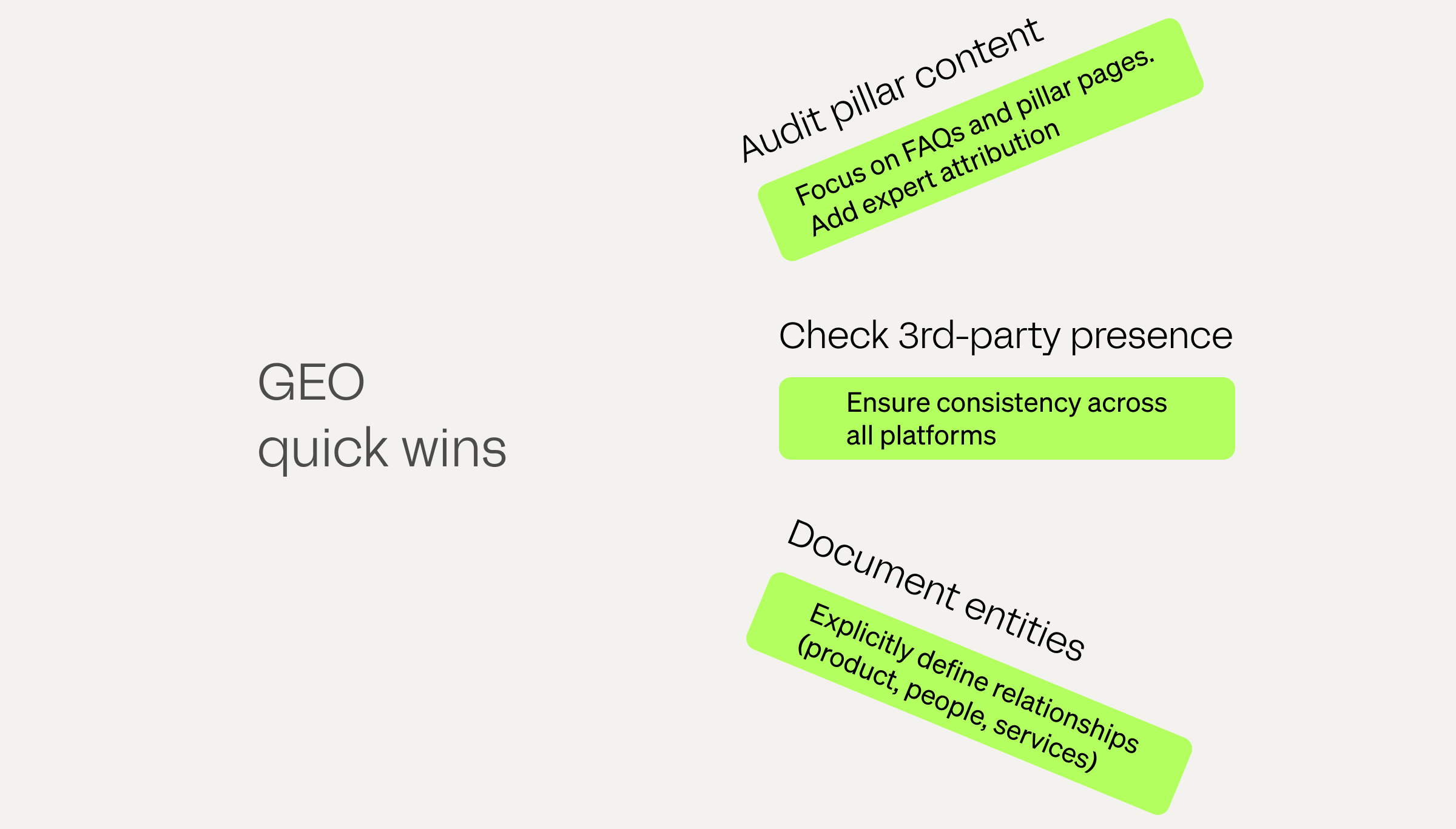
Three practices for enhancing clarity and understanding in communication are illustrated in this image.

Many organizations assume GEO is a future-state initiative that requires new platforms. The reality is more encouraging: you can start applying GEO principles today using practices that align with modern SEO and content discipline. 

The quick wins: 

Start with your FAQ and pillar content. These are highest-value real estate for AI citations. Ensure every answer is directly attributable to a named expert or your brand. Add schema markup that identifies the answer provider. Write with clarity over cleverness. AI models prefer straightforward language they can cite confidently. 

Next, audit your third-party presence. Where are you mentioned on industry sites, review platforms or news outlets? Are those mentions consistent with how your brand is represented on your own site? AI models cross-reference sources, so inconsistency creates confusion and reduces your authority signal. 

Finally, document your entity relationships explicitly. If you're a financial services firm, clarify how your products, services and thought leaders relate using schema markup (e.g., Person → affiliation organization → offers product). Explain these relationships in your content through clear headings and logical flow. LLMs understand semantic relationships. When you make these explicit through both structured data and clear prose hierarchy, you become more interpretable. 

These aren't revolutionary tactics. They're good SEO and content discipline applied through a GEO lens. 

Scaling GEO: When manual practice meets intelligent tooling 

As your GEO practice matures, manual audits and optimization become limiting. This is where purpose-built platforms accelerate impact. 

Adobe LLM Optimizer is designed exactly for this transition. Rather than replacing the work above, it scales it. The LLM Optimizer automates the analysis of how your content performs in generative systems, surfacing gaps at scale and suggesting optimizations that align with both your SEO foundation and GEO goals. 

The results speak for themselves. As outlined in the Adobe Digital Leaders Webinar, The New Front Door: Why Brands Must Optimize for AI Discovery Now, brands using Adobe LLM Optimizer have seen +200% greater LLM visibility versus competitors on key queries, while simultaneously reporting +41% traffic growth from LLM referrals since implementation. That's meaningful because it shows the tool doesn't just optimize for AI mentions. It drives real business results. 

The Valtech approach 

At Valtech, we see GEO as more than a technical challenge. It's a chance to future proof your digital presence.

Through our deep partnership with Adobe Experience Cloud, we help organizations move GEO from concept to competitive advantage via a strategic approach: 

  • Audit and strategize. We assess your current content, metadata and data architecture against GEO principles, identifying where you're vulnerable to invisibility or misrepresentation in AI systems. We create a prioritized roadmap with clear next steps. 
  • Optimize your foundation. We help your teams implement GEO best practices directly, from schema markup strategy to content clarity workshops. This might be manual for your first wave of content. It's about building institutional knowledge alongside process change. 
  • Scale with intelligence. As your practice matures, we integrate tools like Adobe LLM Optimizer into your workflows, turning ongoing GEO optimization from a labor-intensive audit into a systematic, measurable practice. 
  • Design experiences for influence. Throughout, we help you create content that resonates with humans and is interpretable by AI, building influence across both traditional and generative channels. 

Our approach isn't about tearing down what works and starting over. It's about extending your foundation strategically. It's about moving from "visible in search" to "understood by AI" and doing so with speed and confidence. 

The future is already here 

Here's what we know: the way people discover information is changing faster than any of us anticipated. Search isn't disappearing. But it's being joined (in many cases, superseded) by generative engines that don't just retrieve, they reason. 

Brands that adapt their digital strategy to this reality will define the next era of engagement and influence. Those that cling to SEO alone will find themselves slowly fading from the conversations that matter most. 

GEO isn't the end of SEO. It's its evolution, and the recognition that in a generative world, being found is only half the battle. Being understood is everything. 

The question isn't whether to invest in GEO. It's whether you'll invest before or after your competitors do.

Ready to explore how GEO fits into your digital roadmap? Whether you're starting with content optimization basics or scaling with intelligent tooling, Valtech helps leading brands bridge SEO and GEO through strategic partnership and Adobe technology. Let's talk about where your organization stands today and what generative readiness looks like for tomorrow. 

Contact a member of our team

Contact us

Fill in your details and kickstart your transformation journey.

Should you need an alternative format and/or communication support to provide feedback please contact Sheree Atcheson.

Let's reinvent the future