
Are you giving AI a reason to recommend your brand?

Iva Asche,
SVP Adobe Solutions, Valtech
iva.asche@valtech.com

Signaling brand recommendation-worthiness with The Relevance Loop

The Relevance Loop is Valtech's framework for understanding whether a brand earns AI's attention, trust and recommendation. It's built around three connected questions:

  • What should your brand be relevant for?
  • Where and how does it actually show up in AI's answers?
  • How should your experience ecosystem evolve to respond?

These questions used to belong to three different teams on three different timelines. Marketing leadership owned the first. SEO and brand owned the second. IT and operations owned the third. Treating them separately today is why so many GEO efforts stall before they produce anything measurable.

The signals a brand acts on shape where it shows up in AI. What it learns should influence how its brand experiences evolve. How it responds becomes evidence for what matters next.

That's The Relevance Loop: not three separate audits, but one connected system for prioritizing what matters, understanding where you're considered, responding where needed and learning from what happens.
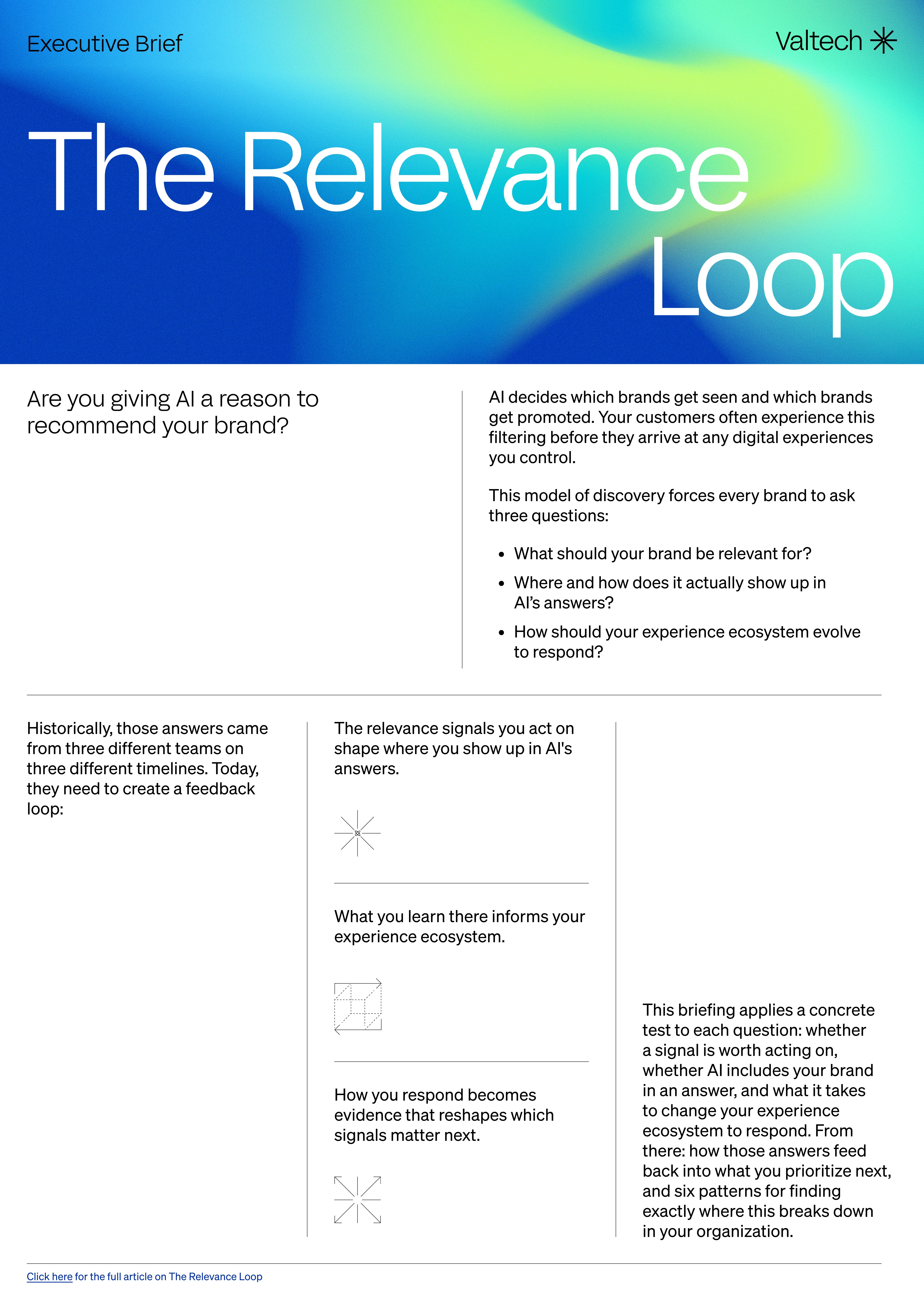
See what the Relevance Loop looks like inside your organization

The executive briefing takes the framework further: how to prioritize relevance, how to think about AI recommendation, what determines your ability to respond — and six recognizable patterns that can help leadership teams pressure-test each decision and recognize patterns that may deserve a closer look.

Download The Relevance Loop briefing

Relevance prioritization: What should your brand be relevant for?

Brands have more signal today than they know what to do with: market intelligence, customer data, social conversation and competitor activity.

Add AI discovery data to that list. Brands know what people are actually asking AI and how they appear in the answers alongside their competitors.

But more signal isn't the same as more clarity.

A relevance signal is only worth acting on when three conditions hold at once:

  • Signal momentum — customers, culture or market interest is meaningfully shifting.
  • Audience propensity — a specific audience is likely to act on it.
  • Brand authority — the brand has the actual right to compete on it.

Miss any one of the three, and the opportunity isn't ready yet, no matter how loud the signal is.

How the loop closes

Relevance isn't fixed; it's continuous. The loop closes when experience-level changes inform relevance signals.

The whole system is dynamic. Customer behavior changes, competitors respond, AI models update their own sense of who's trustworthy. Outcomes must feed back into what gets prioritized next, or an organization ends up relearning the same lesson every quarter.

Adobe Brand Visibility connects GEO actions to changes in AI visibility, while Adobe Analytics and Customer Journey Analytics connect AI-driven engagement to downstream conversion and commercial outcomes. Signal OS brings that evidence back together with market and social signals, customer research, first-party data and audience intelligence.

The result is a richer view of what worked, for whom and whether the original signal still deserves attention.

If you haven't explored the executive briefing yet, discover six patterns that reveal where the Relevance Loop can become disconnected — and the questions worth asking next.

Frequently asked questions

  • What's the difference between AI visibility and AI recommendations?

    AI visibility tells you whether your brand appears in an AI answer. Recommendation goes further: is your brand represented accurately, supported by sufficient authority and ultimately preferred over competitors? A brand can be highly visible without being one AI recommends.

  • What counts as a signal worth acting on?

    One that shows real momentum, has a specific audience likely to act on it and sits inside territory the brand has an actual right to compete in. A trend that fails any one of those three tests isn't ready to act on yet, no matter how much attention it's getting.

  • Is a structural fix always necessary OR Does every AI visibility gap require a technology change??

    No. Some AI visibility gaps can be addressed through optimization at the edge, without changing the CMS or scheduling an engineering sprint. Others point to deeper issues in the content, site structure, components or underlying platform. Those take longer, but they're also the fixes that hold up over time.  

    And sometimes the constraint isn't technology at all. It's the workflow required to prioritize, create, approve and scale the change. 

    The important decision is knowing whether to optimize the surface, evolve the experience, or change how the work gets done. 

  • Does this apply outside consumer brands?

    Yes. B2B buyers research vendors through AI the same way consumers research products. The three questions don't change. What changes is who the audience is and what "authority" looks like in that category.

  • Where should a brand start?

    With whichever of the three questions it can't answer with confidence today. Most organizations can answer one. Very few can answer all three.

  • Who owns this inside an organization?

    No single team, which is the point. Marketing, brand, content, comms, CX and technology each shape a different part of the loop. Fixing one condition without coordinating the others usually just moves the gap somewhere else.