


The advice gap the industry has worried about for a decade is finally closing. Just not in favour of regulated firms. Someone in that 26% is, right now, asking an assistant whether to overpay a mortgage, move a pension or cancel a policy. No one is checking the answer suits them, no one is accountable if it's wrong, and it's happening at scale.
This isn't hypothetical. When Which? tested the leading assistants in late 2025, it asked how to invest a "£25,000 ISA allowance": a deliberate trap, because the real limit is £20,000. ChatGPT and Copilot both missed it and advised on the wrong figure, the kind of error that could push a customer into breaching HMRC rules. That's the pattern: competent on general principles, unreliable on the specific, personal calculations that carry real consequences — and delivered with exactly the same confidence as a right answer.
In July, an independent report to HM Treasury (the Financial Services AI Adoption Plan) set out ten recommendations for scaling AI across UK financial services. Most of it is sensible and already widely summarised. This piece is about the part that changes what a regulated firm should do next: the question the report left open, and why waiting for the answer is the most expensive move available.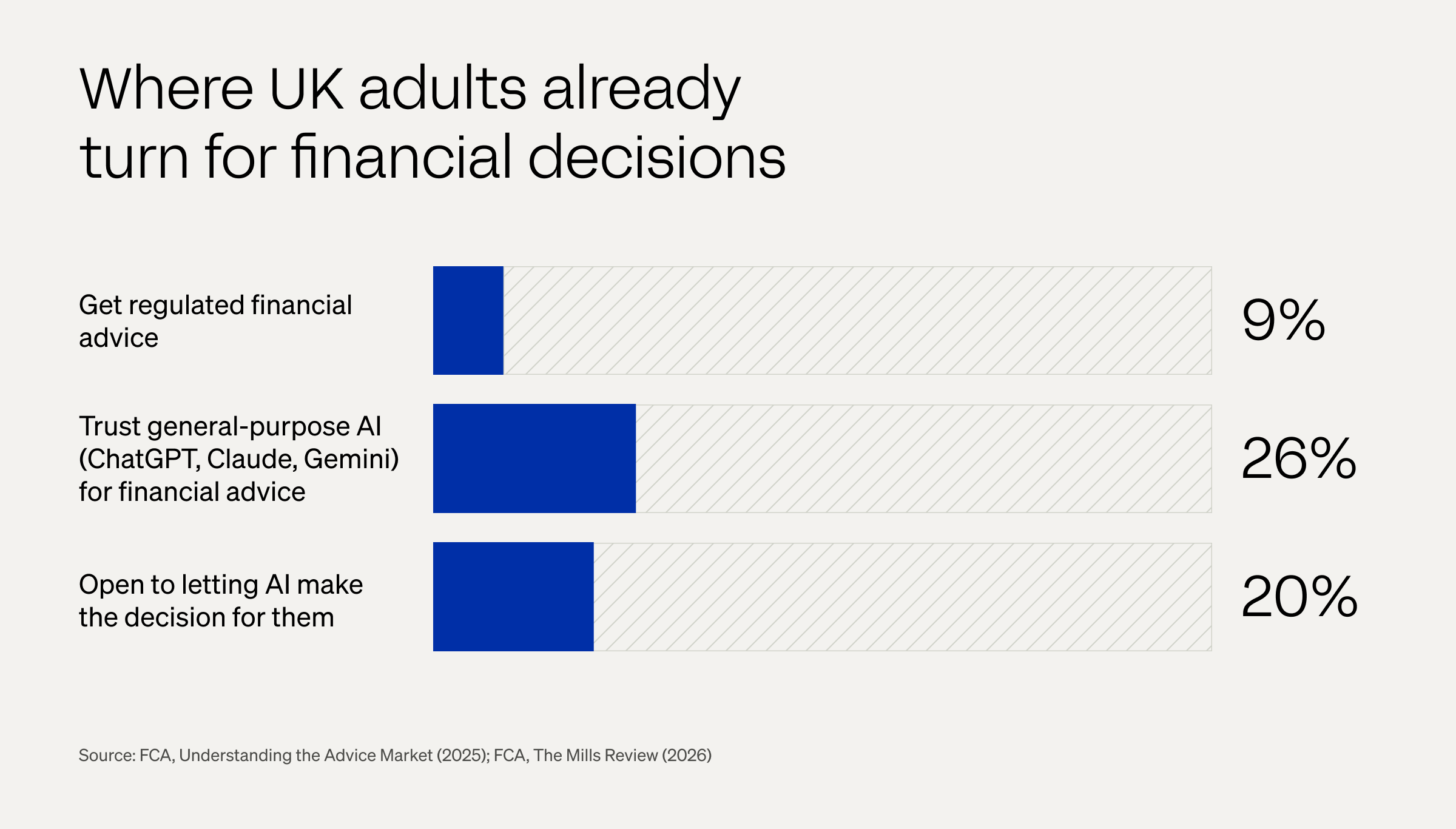
The question the report leaves open
That 26% isn't a rounding error, and it isn't waiting for an FCA process to resolve. Regulated financial advice (the kind where a qualified firm recommends what you personally should do, and answers for it) is expensive to give, so it never reaches most people. Targeted support and awareness campaigns have nudged the number without changing it. A free, instant assistant changes it overnight, and one in five UK adults now say they're open to letting AI decide for them, not just inform them.
The report's answer is to ask the FCA to review the regulatory perimeter for AI-enabled services: the boundary around what counts as a regulated activity. Step inside it (telling a customer what they personally should do with their money) and you need FCA authorisation. Stay outside it (giving general information or guidance) and you don't. The report leaves that line for the FCA and government to draw, saying plainly that it has "intentionally not defined or prescribed" where the new boundary should fall.
That's the right call for an independent report. It's the wrong posture for a bank, an insurer or a wealth manager to adopt.
Waiting is the expensive option
Here's the trap. A regulated firm's instinct is to wait for clarity. The perimeter is unresolved, the FCA review hasn't started, and moving early into a grey area feels like the risky choice. So the plan becomes: prepare, watch, and act once the rules are firm.
The problem is what happens during the wait. A perimeter review runs for months, then policy work, then implementation. Through all of it, customer trust and habit keep migrating: not to your app, but to an assistant that answers instantly, for free, at eleven at night, about whether to move a pension.
Trust and habit are sticky. Once a customer's default question about their money goes to a general-purpose model instead of the institution that holds it, that's hard to reverse. By the time the perimeter is redrawn, the relationship you were protecting has already thinned.
Inaction isn't the safe option here. It's the slow, deniable version of losing.
Consumer Duty is the permission, not the brake
Here's the reframe. Consumer Duty (the FCA rule that requires firms to deliver good, fair outcomes for retail customers) is treated by most firms as the reason they can't move quickly on AI. It's the opposite. It's the framework that lets them move now, inside the boundary as it already stands.
You don't need the perimeter review to act. You need the discipline to stay on the right side of a line that already exists: the line between guidance and regulated advice. Guidance that informs, explains and narrows a customer's options, without making a personal recommendation, is something a regulated firm can build today. Consumer Duty gives you the standard to build it well: evidence that outcomes are fair, that vulnerable customers are protected, that the customer understood what they were told, and that every output can be explained after the fact.
That's not compliance bolted onto an AI product. It's the product's advantage. An unregulated assistant can't evidence a fair outcome, can't detect a vulnerable customer and route them to a human, and can't show a regulator why it said what it said. A regulated firm can design all three in from the first line of code, which is exactly the trust an anxious customer is looking for and not getting from a chatbot. That asymmetry only holds if regulated firms sit still: the moment you offer trusted, evidenced, Consumer Duty-led guidance, the obligation stops being a weight and becomes the reason a customer chooses you.
What to do this quarter, inside today's rules
This isn't a call to move recklessly into regulated advice ahead of the FCA. It's the opposite: a call to be precise about where the line sits, and to build hard against it now. Three moves are available without waiting for a single rule to change.
Getting the scope wrong is a real cost. Guidance that drifts into a personal recommendation without authorisation is a regulatory breach, and a badly routed vulnerable customer is the kind of failure that shows up in an FCA review. The discipline isn't a constraint on the opportunity: it's what makes the opportunity defensible. That's why each of the three moves below is built around evidence, not enthusiasm.
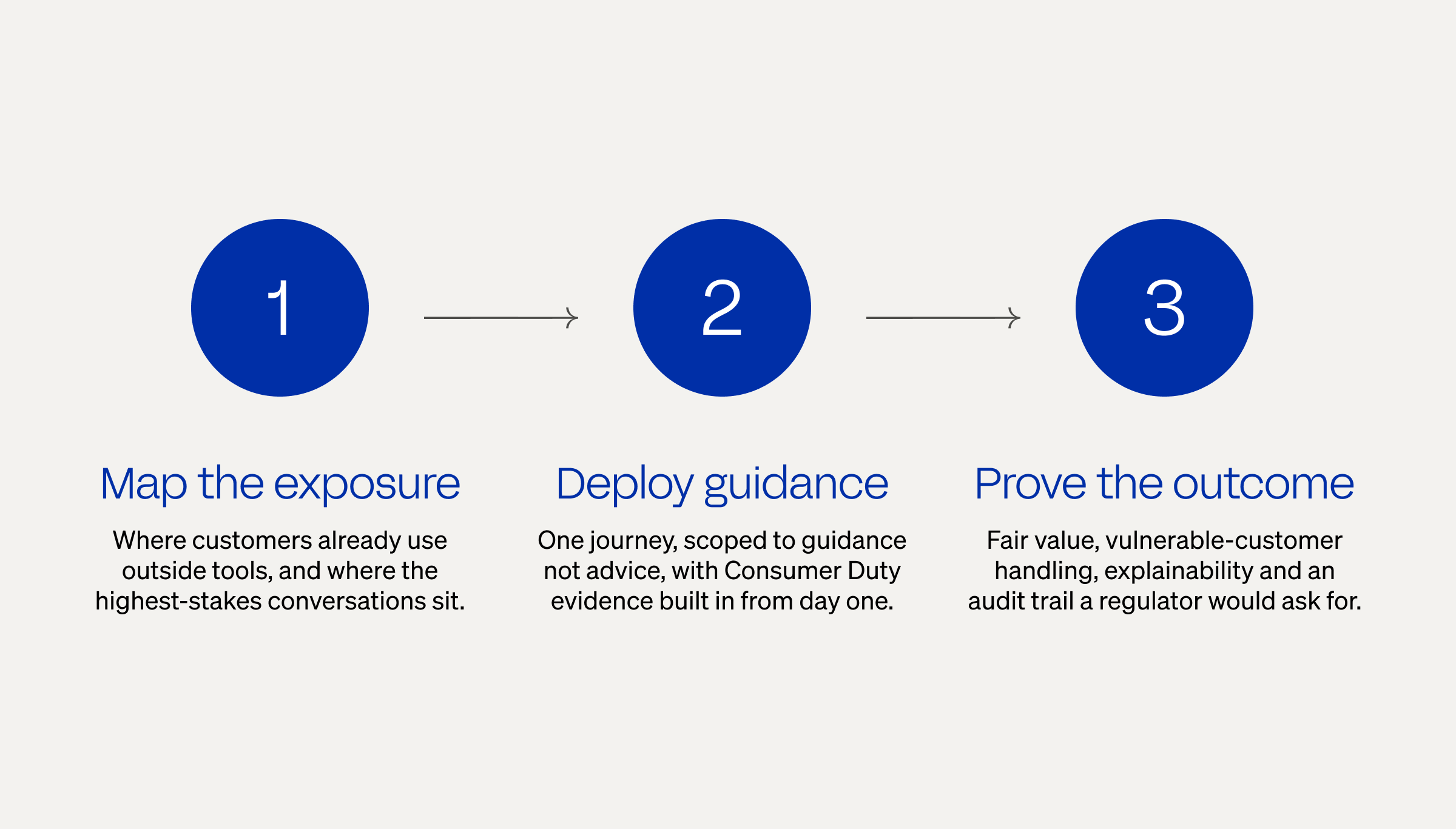
First, map it: where customers already use outside tools, and where the highest-stakes conversations sit, across savings, debt, retirement, cover and claims. That's your exposure and your opportunity in one view.
Second, deploy it: pick one of those journeys and scope it to guidance, not advice, with Consumer Duty evidence built in from day one rather than retrofitted later. Build the boundary into the product itself, with a rules-based trigger that hands off to a qualified adviser the moment a query moves from "what are my options" to "what should I do".
Third, prove it: fair value, vulnerable-customer handling, explainability, and an audit trail a regulator would ask for. That evidence is both your Consumer Duty defence and your case for scaling to the next journey.
Not every firm should lead here. One with no digital guidance capability and no clean customer data has foundations to lay first. But most large UK banks, insurers and wealth managers already have the pieces. What they lack is the decision to use them before the rulebook tells them they may.
The point
The Adoption Plan asks the right question and leaves it open on purpose. Firms that read that as "wait" will spend the next two years watching their most valuable customer conversations move somewhere they can't follow. Firms that read it as "the line already exists, and Consumer Duty is how we build against it" will own the trusted-guidance ground before the review that was meant to create it has even reported.
The perimeter review will come. The question is whether it finds you ready to compete, or ready to explain why you waited.
Where to start
Valtech runs a short, fixed-scope Consumer Duty AI Review for financial services firms. We map where your customers are already turning to unregulated AI, identify the guidance journeys you can launch inside today's rules, and set out the Consumer Duty evidence for the highest-value one.
You leave with a clear view of your exposure and your fastest safe move, whether or not you build it with us. Get in touch to talk it through.
Key takeaways
26% of UK adults already trust general-purpose AI for financial decisions, against just 9% who get regulated advice. The gap is closing in AI's favour, not the industry's.
The tools are competent on general principles but unreliable on personal calculations: in a 2025 Which? test, ChatGPT and Copilot both missed a planted error on the ISA limit and advised on the wrong figure.
Waiting for the FCA's perimeter review isn't the safe option. Customer trust and habit are migrating to unregulated tools now, and that behaviour is hard to reverse once formed.
Consumer Duty already gives regulated firms the standard to build trustworthy, evidenced AI guidance today, without waiting for the perimeter to be redrawn.
The line to build against is guidance versus regulated advice, not "wait for new rules". Getting the scope right protects the opportunity; getting it wrong is a regulatory breach.
Three moves this quarter: map where customers are exposed, deploy guidance (not advice) in one journey with Consumer Duty evidence built in, then prove the outcome.
Sources
Every figure in this piece is drawn from the Financial Services AI Adoption Plan and its underlying sources, as follows:
-
Financial Services AI Adoption Plan — HM Treasury, independent report, published 14 July 2026. Crown copyright, Open Government Licence v3.0. gov.uk/government/publications/ai-adoption-plan-financial-services
-
"Around 9% of UK adults receive regulated advice" — FCA, Understanding the Advice Market: Financial Advice Firms Survey 2025, published 23 April 2026. fca.org.uk/data/understanding-financial-advice-market
-
"Around 26% trust general-purpose tools for financial advice; 1 in 5 UK adults open to AI making decisions for them" — FCA, The Mills Review: AI and the Future of Retail Financial Services, 2026. fca.org.uk/publication/corporate/the-mills-review.pdf
-
ISA allowance test (ChatGPT and Copilot advising on a £25,000 figure when the limit is £20,000) — Which?, "Can AI answer your money questions?", November 2025. which.co.uk/news/article/can-ai-answer-your-money-questions