Contact us

Why GEO is the next frontier in digital visibility

SVP Adobe Solutions
Valtech

July 01, 2026

For decades, marketers optimized for ranking. They refined keywords and built content around algorithms that decided who won digital real estate. Search engine optimization became the common language of digital strategy.

That has shifted. And if you're still thinking about digital visibility purely through an SEO lens, you're missing the biggest change since the rise of mobile. 

Users aren't just searching anymore. They're asking. And increasingly, they're getting answers not from a list of blue links, but from AI systems that synthesize, summarize and serve insights directly into the conversation. 

This is the era of generative engine optimization (GEO), and it’s redefining what visibility means. 

We've gone from algorithms to answers 

Let's start with the data.

The shift is measurable. According to Bain & Company, 60% of searches now end without a single click to a website, and 80% of consumers rely on AI-generated answers for a significant share of their searches. The traffic that does come through is worth more.  

This creates a new paradox for brands with AI guarding search: fewer clicks, but higher-intent consumers who visit the website, looking for answers beyond what AI has surfaced. SEMrush, an Adobe company, finds AI-referred visitors convert at 4.4 times the rate of traditional organic search.  

Generative engines like ChatGPT, Gemini, Claude, Copilot and Perplexity are becoming the new gatekeepers of content. They're sensemaking engines that don't just retrieve information; they interpret, synthesize and contextualize it. And crucially, they decide whose voice gets heard in the conversation. 

The consequence is stark: “zero-click” interactions are climbing. Users find their answers without ever visiting your website. And the AI compresses the research-to-decision journey inside the chat, so the visitor who clicks arrives pre-qualified.  

For digital leaders, the question is no longer “How do we rank?” It’s “How do we get understood?” and “How do we respond to the highest-intent source of traffic?” 
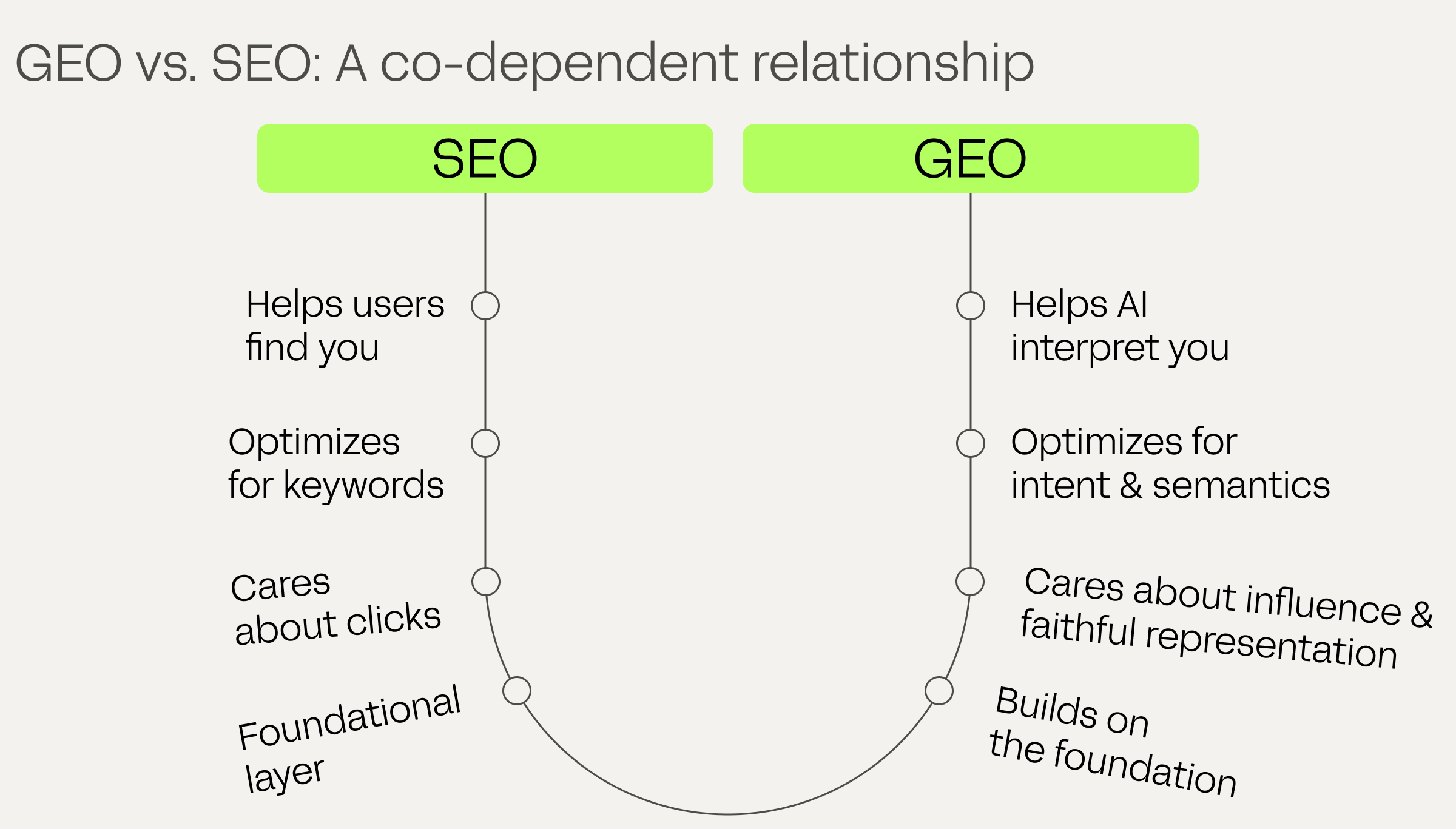
GEO vs. SEO: A false choice

Here's where many organizations get it wrong: they see GEO as a replacement for SEO. A pendulum swing from one discipline to another. 

That's a mistake. 

The truth is more nuanced and far more strategic. SEO and GEO are co-dependent layers of a modern digital ecosystem. 

SEO remains foundational. It ensures your content is structured, discoverable and authoritative in traditional search. It's the hygiene layer: metadata, schema markup, backlinks, content authority. Without it, you're invisible to both search crawlers and AI models. 

But GEO builds on that foundation. It answers a different question: How do AI systems understand and represent your brand? 

This means:

  • SEO helps users find you. GEO helps AI systems interpret you accurately enough to cite, trust and include you in their answers. 
  • SEO optimizes for keywords. GEO optimizes for intent, entity relationships and semantic understanding. 
  • SEO cares about clicks. GEO cares about influence and whether your expertise is represented faithfully in AI-generated responses. 

Neglect SEO, and your content never reaches the systems in the first place. Neglect GEO, and your content gets misunderstood, misrepresented or attributed to competitors. 

The winners won't be those who choose between SEO and GEO. They'll be the ones who see them as an integrated whole. 

The architecture of interpretation: How brands become "understandable" 

Here's what's changing about content strategy: it's no longer enough to be found. You have to be interpretable. 

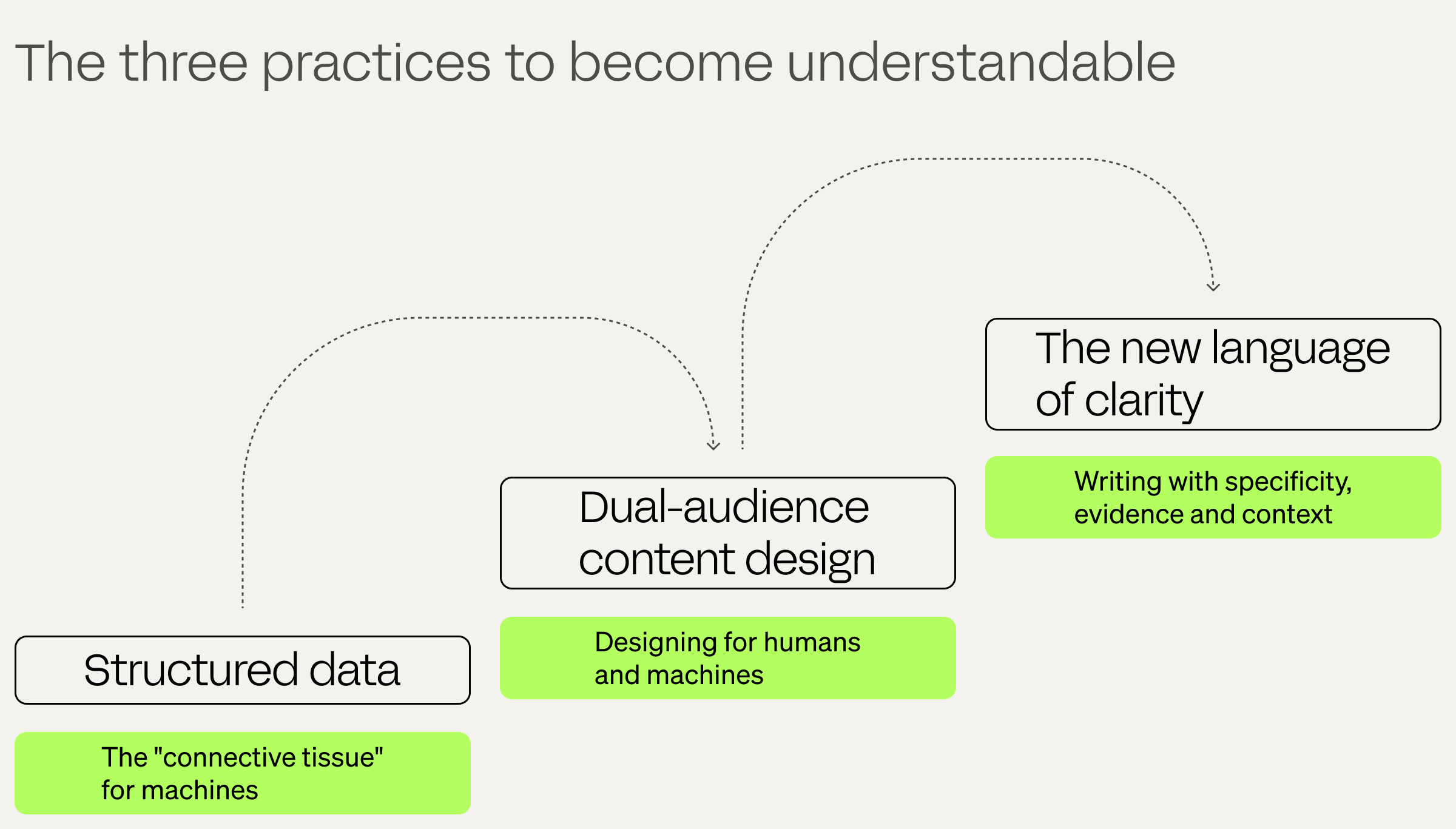
Three practices are emerging as table stakes: 

1. Structured data as connective tissue

In a generative world, schema markup, entity tagging and linked data are essential. Structured data tells AI systems what your content is about, how it relates to other information and why it matters. It's the bridge between human language and machine understanding. Without it, even brilliant content becomes noise in the model's training data.

How to start: Implement organization, person and product schema markup on your key pages. This makes it easier for LLMs to extract and cite your content cleanly. But schema works best when paired with semantic consistency: your brand name, description and expertise are described identically across your own site and third-party mentions.

2. Content design for dual audiences

Traditional web design asks: "How do users navigate this?" Modern GEO-ready design asks: "How do humans and machines navigate this?" 

This means consistent, context-rich metadata across every piece of content. It means hierarchies that map to business entities, not just website menus. It means every piece of content has a clear semantic purpose. Not just keyword coverage, but topic depth and topical authority. 

How to start: Audit your top 50 pages. For each, document: What is this page's single core entity or topic? Who authored it? What's the authority signal? Then standardize meta descriptions and H1s to reflect that intent clearly. AI models need coherence. Write title tags and introductions that state intent explicitly, not vaguely. 

3. The new language of clarity

Forget keyword density. GEO demands something more rigorous: intent modeling through clarity. 

Every word becomes a signal. Brands need to write with precision, evidence and purpose so that AI systems can confidently cite their expertise. You're not just writing for your audience anymore. You're writing for algorithms that will decide whether to trust and attribute your work. 

How to start: Rewrite key content with three principles: specificity (avoid vague terms and name what you mean), evidence (back claims with data, sources or expert attribution) and context (explain the "why" alongside the "what"). Include bylines and expertise markers to help models understand who's speaking and whether they should trust them. 

None of this is fundamentally new. It is good SEO and content discipline applied through a GEO lens, and you can start today without waiting for a single new tool. 

Scaling GEO: When manual practice meets intelligent tooling 

Manual audits stop scaling quickly. This is where a purpose-built platform earns its place.

Adobe Brand Visibility is designed exactly for this transition. Rather than replacing the work above, it scales it. The LLM Optimizer automates the analysis of how your content performs in generative systems, surfacing gaps at scale and suggesting optimizations that align with both your SEO foundation and GEO goals.

The results speak for themselves. As outlined in the Adobe Digital Leaders Webinar, The New Front Door: Why Brands Must Optimize for AI Discovery Now , brands using Adobe Brand Visibility have seen more than 200% greater LLM visibility versus competitors on key queries, while simultaneously reporting more than 41% traffic growth from LLM referrals since implementation. That translates AI visibility into higher-intent traffic and real business results.

From GEO tooling to GEO ownership.

Everything above is the first half of the GEO equation. The content, the structure, the tooling that makes you interpretable, and the platform that scales it. It is real work, and most brands haven't done it.

But it is the easier half.

Because once the tooling is in place, one question is left, and no product on the market answers it: Who owns GEO?

Notice the question isn't: Who runs the audit one time?

Who owns this? reflects an ongoing discipline, across brands, across markets, when the org chart has no box for it and no single name against it. In SEO, there was a No. 1 ranking and someone owned it. In GEO, the metric is how often you show up across assistants and answers, and ownership tends to belong to everyone, and therefore no one.

That's where most enterprises come unstuck: not on the technology, but on the operating model around it.

Curious to understand how GEO fits into your organization's operating model? Our GEO QuickStart is a fast way to find out.

Book a GEO QuickStart intro call →

Let’s connect

Fill in your details and kickstart your transformation journey.

Should you need an alternative format and/or communication support to provide feedback please contact Sheree Atcheson.